Love Elli: A Handwritten Font Pair for Craft Projects
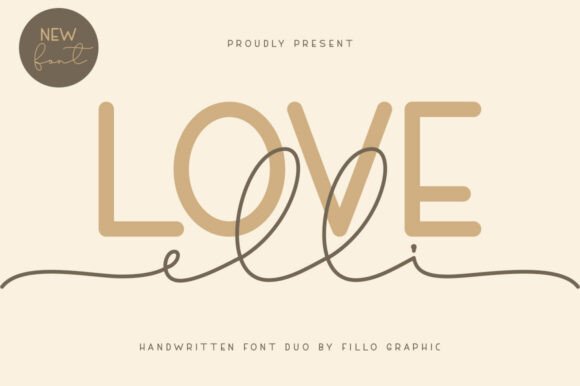
Love Elli is a pair of complementary handwritten fonts—Love Elli and Love elli—designed to work together seamlessly while also functioning independently. Both fonts reflect a relaxed, natural script aesthetic with subtle bounce and warmth, avoiding overly formal or rigid calligraphic structures. The uppercase “Love Elli” font features slightly bolder strokes and more pronounced letterforms, while the lowercase “Love elli” offers softer curves, delicate terminals, and gentle variation in stroke weight. Together, they form a cohesive typographic system ideal for crafters, small-business owners, and designers seeking expressive, hand-crafted typography without needing custom lettering skills.
Why Consider Love Elli?
Designers and makers often seek typefaces that convey authenticity, approachability, and personality—qualities difficult to achieve with standard sans-serif or serif fonts. Love Elli meets this need by offering two distinct yet harmonized handwritten styles. Its appeal lies not only in visual charm but in functional design choices: consistent spacing, balanced x-heights, and thoughtful kerning pairs that support readability at common craft sizes (e.g., 24–72 pt for vinyl decals, greeting cards, or printable labels).
One practical reason users explore Love Elli is its PUA (Private Use Area) encoding. This means alternate glyphs—including swashes, ligatures, and stylistic variants—are accessible directly through standard character mapping tools in design software (e.g., Adobe Illustrator’s Glyphs panel or Affinity Designer’s Character panel). No complex OpenType feature setup is required, making advanced typographic expression available even to those with limited font-technical knowledge.
Key Benefits
- Visual harmony: Love Elli and Love elli share baseline alignment, proportion, and rhythm, allowing effortless mixing in headlines, subheads, and body text without visual dissonance.
- Hand-crafted flexibility: Swashes and alternates enable customization—such as adding flourishes to initials or varying word endings—without switching fonts or manually redrawing letters.
- Craft-ready output: Clean vector outlines ensure crisp rendering when cutting vinyl, engraving wood, or printing on textured paper.
- Time efficiency: Having two coordinated fonts reduces the need to source, test, and license separate scripts for layered layouts (e.g., a bold title paired with a lighter subtitle).
Tradeoffs and Considerations
Like most handwritten fonts, Love Elli prioritizes expressiveness over utility in extended reading contexts. It is not intended for long-form body copy, UI interfaces, or accessibility-critical applications where legibility at small sizes or screen contrast matters most. At under 12 pt, letterforms may begin to lose clarity, especially in digital formats or low-resolution outputs.
The font pair does not include extensive language support beyond basic Latin characters (A–Z, a–z, numerals, common punctuation). Users working with accented characters (e.g., é, ñ, ü) or non-Latin scripts (Cyrillic, Greek, Arabic) will find coverage limited. Additionally, while PUA encoding simplifies access to alternates, it does not replace full OpenType layout features like contextual alternates or automatic ligature substitution—so manual glyph selection remains necessary for fine-tuned control.
Licensing is another practical factor. Love Elli is typically offered as a commercial font requiring a license for business use (e.g., product packaging, client work, or digital templates sold on marketplaces). Free personal-use versions may exist, but their redistribution or modification is usually prohibited. Always verify license terms before deployment.
When Love Elli Is a Strong Fit
Love Elli suits projects where tone, texture, and tactile quality matter more than neutrality or scalability. Examples include:
- Handmade product labels (candles, soaps, bath salts) where typography reinforces artisanal identity;
- Wedding stationery (invitations, menus, signage) seeking warmth and individuality;
- Digital craft templates (Canva, Silhouette Studio, Cricut Design Space) aimed at hobbyists who value ready-to-use, well-matched fonts;
- Social media graphics for small creative businesses emphasizing approachability and handmade aesthetics.
In these cases, the ability to switch between two stylistically unified fonts—without mismatched proportions or clashing energy—adds consistency across touchpoints, from physical goods to digital previews.
When Alternatives May Be Worth Exploring
If your project demands multilingual support, strict accessibility compliance, or integration into responsive web environments (e.g., CSS @font-face with variable weight or width), Love Elli may fall short. Fonts with broader character sets (e.g., Handwriting or Brilliant Bright) or variable-font capabilities offer more technical flexibility.
For users needing high legibility at small sizes—such as instructional printables or pattern guides—a more structured script (e.g., La Vie Parisienne) or a hybrid script-sans pairing might serve better. Similarly, if budget constraints limit licensing options, open-source alternatives like Quicksand (though not handwritten) or Indie Flower provide usable, no-cost options—though without the dual-font coordination or PUA convenience of Love Elli.
Making an Informed Decision
Evaluating Love Elli begins with clarifying your primary use case. Ask yourself:
- Is the goal to enhance visual cohesion across multiple craft elements (e.g., a logo, tagline, and product description)? If yes, Love Elli’s paired design reduces trial-and-error.
- Do you regularly use swashes or alternate characters—and do you prefer accessing them via intuitive glyph panels rather than code-based features? Then PUA encoding is a meaningful advantage.
- Will the font appear mostly at larger sizes on physical materials? If so, Love Elli’s strengths align well with your needs.
- Are you comfortable reviewing and adhering to commercial license terms—or is this for internal, non-distributed use only?
No single font solves every typographic challenge. Love Elli excels in specific contexts—not as a universal solution, but as a purpose-built tool. Its value emerges most clearly when matched to goals centered on expressive, tactile, and visually unified craft communication. For users whose priorities match those criteria, it offers reliable performance and thoughtful design. For others, evaluating alternatives against the same decision criteria—use case, technical requirements, licensing, and long-term maintainability—will lead to a more sustainable choice.