Bahama
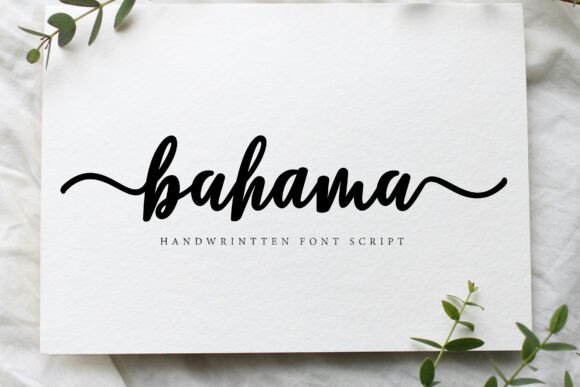
There’s a quiet confidence in handwriting that feels personal, intentional, and human — and Bahama captures that spirit without sacrificing polish. It’s not just another script font; it’s a carefully crafted typeface with rhythm, warmth, and subtle bounce — the kind that makes a logo feel inviting, a greeting card feel heartfelt, or product packaging feel thoughtfully designed. Whether you're naming a small-batch candle line, designing Instagram story quotes for your coaching business, or printing name tags for a community workshop, Bahama delivers character *and* clarity.
What People Often Misunderstand About Bahama
Many assume Bahama is “just a decorative script” — something to use sparingly, only for headlines or flourishes. That’s understandable, but it overlooks how versatile Bahama really is. Its design balances legibility with personality: generous x-height, open counters, and consistent stroke contrast make it readable even at smaller sizes (like on a 2 oz soap label or a folded greeting card). Yet its fluid joins and natural-looking terminals keep it feeling handwritten — never robotic.
Another common misconception? That any script font will do the job if it “looks nice.” But not all scripts support full language needs. Bahama includes a complete set of uppercase and lowercase letters, standard punctuation, numerals, and typographic essentials like curly quotes and em dashes — meaning you won’t hit a wall when typing a full sentence, pricing details, or contact info.
Skipping the Character Set Check
Before downloading or purchasing Bahama, open the font preview and scroll through the full glyph set — especially if you plan to use it internationally or with special terms (e.g., accents, symbols, or industry-specific abbreviations). Some free versions omit ligatures, alternate characters, or extended punctuation. If your brand name includes an ampersand or your product packaging lists ingredients with degrees (°C) or trademarks (™), verify those glyphs exist. Missing characters force workarounds — like mixing fonts mid-sentence — which breaks visual harmony and weakens brand consistency.
Overlooking Contextual Alternates
Bahama includes smart OpenType features like contextual alternates — subtle variations that prevent awkward letter collisions (like “st”, “tt”, or “ff”) and improve spacing automatically. But these only activate in apps that support OpenType (e.g., Adobe Creative Cloud, Affinity apps, recent versions of Canva Pro, or Figma with plugins). In basic tools like Google Docs or older versions of Microsoft Word, you’ll get the default character set — functional, but less refined. If fine-tuned typography matters to your project, test Bahama in your actual workflow first.
Assuming It Works Equally Well Everywhere
Script fonts shine in print and high-resolution digital displays — but can soften or blur on low-DPI screens or compressed social media thumbnails. For example, using Bahama as your Instagram bio font may look elegant on desktop but turn muddy on a mobile feed. A better approach? Reserve Bahama for hero visuals (cover photos, story highlights, printed cards), and pair it with a clean sans-serif for body text or captions. This preserves impact *and* ensures your message stays clear.
Ignoring Licensing Scope
Bahama is often available in both free and premium versions — but the license terms differ significantly. The free version may allow personal use only, while commercial projects (like selling branded merchandise or using it in client work) require a proper license. Using an unlicensed font in a Shopify store banner or printed product tag isn’t just risky legally — it also reflects poorly on professionalism. Always check the license before launch. Reputable sellers (like Creative Market or MyFonts) list usage rights clearly — look for terms like “commercial use,” “web embedding,” or “desktop + app licensing.”
How to Use Bahama More Effectively
Start simple: try Bahama for one high-impact element first — a shop name on a storefront sign, a quote overlay on a blog header image, or the “Thank You” line inside a thank-you card. Let its personality anchor the design, then build around it with neutral supporting fonts and ample white space.
For logos, avoid stretching or distorting Bahama. Its charm lies in its natural proportions — so resist the urge to condense it for tight layouts or overscale it for emphasis. Instead, adjust tracking (letter spacing) slightly to improve balance — tighter for uppercase acronyms, looser for longer names — and always preview at actual size.
On packaging, consider how Bahama interacts with materials. Matte paper softens ink spread, enhancing its organic feel. Glossy finishes may sharpen contrast, making fine strokes pop — but test a physical proof. What looks perfect on screen can shift subtly once printed.
What to Verify Before You Commit
- File format compatibility: Ensure the download includes .OTF (OpenType) files — they offer broader feature support than .TTF, especially for advanced typographic control.
- Language coverage: If your audience uses accented characters (e.g., “café,” “naïve,” or “jalapeño”), confirm Bahama supports Latin-1 or Latin Extended-A Unicode ranges.
- Design cohesion: Try typing your brand name, tagline, and a short sentence in Bahama alongside your current sans-serif or serif font. Does the contrast feel intentional — or jarring? Good pairing creates hierarchy, not confusion.
- Real-world rendering: Export a mockup to your phone and view it at 100% zoom. Does the flow hold up? Are descenders (like “g” or “y”) clear? Is spacing even?
Bahama doesn’t demand attention — it earns it. Its strength isn’t in being flashy, but in feeling quietly right: the kind of typeface that makes people pause, read twice, and remember the feeling behind the words. When chosen with intention — and used where its strengths align with your goals — it becomes more than decoration. It becomes part of your voice.
If you’ve ever hesitated before choosing a script font, wondering whether it will scale, translate, or last beyond a trend — that hesitation is useful. It means you care about how your work is received. Bahama rewards that care with reliability, grace, and a rare kind of authenticity.